
How to tell if an AI agent is actually good at your cloud (and what AWS's aws-bench measures)
TL;DR. An AI agent will give you a confident, well-written answer to a question about your AWS account whether that answer is right or wrong. In a cloud environment, acting on a wrong answer can be costly. The only way to know if an agent is actually accurate is to test it against a known-correct answer. That is what AWS’s new aws-bench does: each test pairs a real question with a defined cloud state and the verified correct answer, so you can check whether the agent was actually right. When you evaluate any AI tool for your cloud, the thing to check is whether you can verify its answers, not just whether they sound reasonable.
Why a confident answer isn’t a correct one
An AI model will produce a well-structured, authoritative-sounding answer even for a question it cannot answer correctly, and that answer looks the same as one it got right. There is no visible difference between a confident correct answer and a confident wrong one.
That is a minor issue in a chatbot and a serious one in a cloud account. If an agent tells you a security group is unused and you delete it, and it turns out to be wrong, you own the outage. That cost is why “sounds reasonable” is not a good enough standard for AI working in your cloud.
So the useful question is not whether an agent writes well. It is whether you can verify what it tells you.
What is aws-bench?
aws-bench is an open-source benchmark, released by AWS as a research preview, that measures how accurately and efficiently AI agents complete real-world AWS tasks. It exists because model providers and researchers building agents that operate on AWS need an objective, reproducible way to measure performance and diagnose failures — instead of trusting a demo.
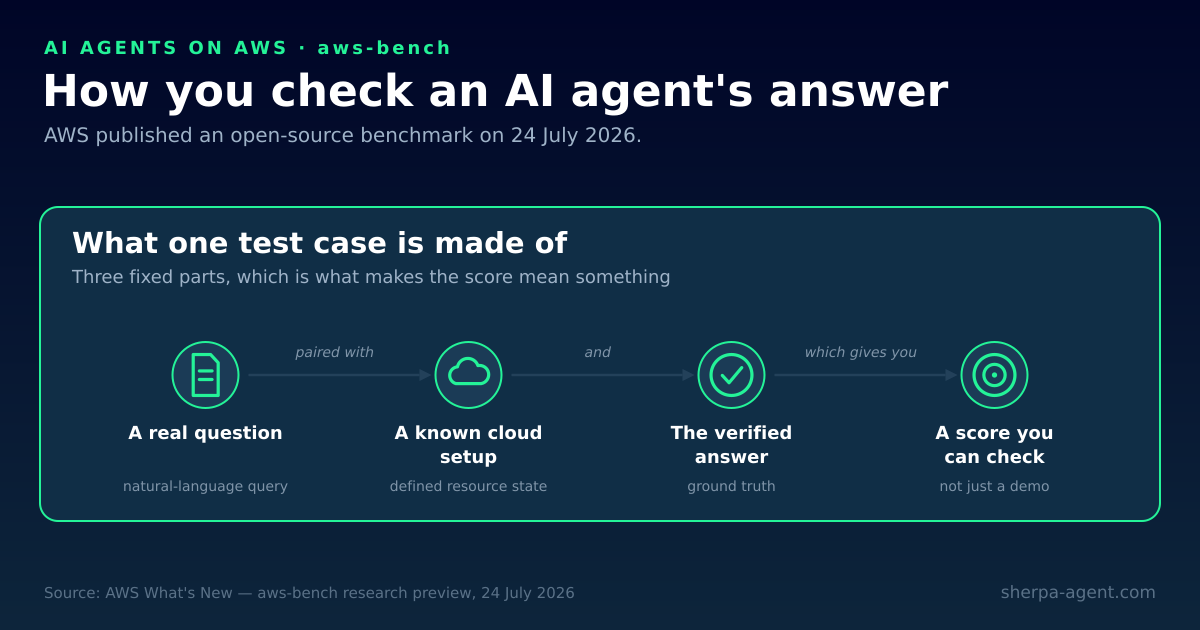
The design is the interesting part. Each test case pairs three things:
- A natural-language query — the kind of question you’d actually ask, drawn from real AWS usage: investigation, troubleshooting, and infrastructure-creation tasks.
- A defined cloud resource state — the environment set up in a specific, known configuration.
- A ground-truth answer — the verified correct result for that state.
Because all three are fixed, you can score any agent or model on the same task and get a consistent, verifiable result. It checks whether the agent reached the known-correct answer — not whether its response reads well.
Why the ground truth is the hard part
Anyone can write test questions. The part most AI demos quietly skip is the third ingredient: a verifiable correct answer to grade against. Without it, you aren’t measuring accuracy — you’re measuring how convincing the output is.
That’s the whole reason a benchmark like aws-bench is worth attention. A known cloud state plus a known correct answer turns “the agent said something plausible” into a result you can check. It replaces a subjective judgment with a clear pass or fail.
How this maps to evaluating a cloud AI for real work
You’re probably not running a research benchmark. But the same principle decides whether a cloud AI is trustworthy in production:
- Can its answers be checked against your real environment? An agent grounded in your actual resource state can be verified; one improvising from training data can only be trusted.
- Does it show its work? The specific resource, the query, the evidence — so you can confirm the answer rather than take it on faith.
- Is a human in the loop before anything changes? Verification matters most exactly when the agent proposes an action. A person should approve before a resource is touched.
An agent that can be checked is worth more than one that’s merely persuasive.
How different industries could use a benchmark mindset
The “verify, don’t trust” standard matters wherever a wrong-but-confident answer crosses a line that’s supposed to hold.
- Financial services. Regulated environments can’t act on an unverifiable claim about who can access what or where data sits. An answer graded against the real account state is auditable; a fluent guess is a finding waiting to happen.
- Healthcare. When an agent reasons about access to systems near patient data, “it sounded right” is not a control. Grounding an answer in the actual configuration is what makes it defensible.
- Public sector and education. Teams stretched thin lean hardest on automation — and are least able to absorb an outage from acting on a wrong answer. Verifiability is what makes the leverage safe.
- SaaS and platform teams. Where an agent touches multi-tenant infrastructure, a confidently wrong action is a tenancy incident. A checkable answer is the difference between speed and risk.
- Data and analytics. The highest-value systems concentrate the most damage from a wrong move; the case for grading answers against known truth is strongest exactly there.
The common thread: the more consequential the environment, the less “confident” is worth and the more “checkable” matters.
FAQ
What is aws-bench?
An open-source benchmark from AWS (released as a research preview) that measures how accurately and efficiently AI agents complete real-world AWS tasks. Each test pairs a natural-language query, a defined cloud resource state, and a verified ground-truth answer, so any agent can be scored on a consistent, reproducible basis.
Why isn’t a confident AI answer good enough?
Because a fluent wrong answer looks identical to a fluent right one, and in a cloud environment acting on the wrong one causes real cost or outages. Confidence is not evidence of correctness — only checking against a known-correct answer is.
What does aws-bench actually measure?
Whether an agent reaches the verified correct answer for a task, given a known cloud state — accuracy and efficiency on real AWS work (investigation, troubleshooting, infrastructure creation), not how well-written the response is.
How should I evaluate an AI agent for my own AWS environment?
Ask whether its answers can be verified against your real environment, whether it shows the specific resource and evidence behind each answer, and whether a human approves before it changes anything. Prefer an agent that can be checked over one that is merely persuasive.
Is aws-bench something I run myself?
It’s aimed at model providers and AI researchers building and improving agents. For most teams it’s more useful as a principle — evaluate any cloud AI by whether its answers are verifiable against ground truth — than as a tool you run directly.
See what Sherpa finds in your AWS.